
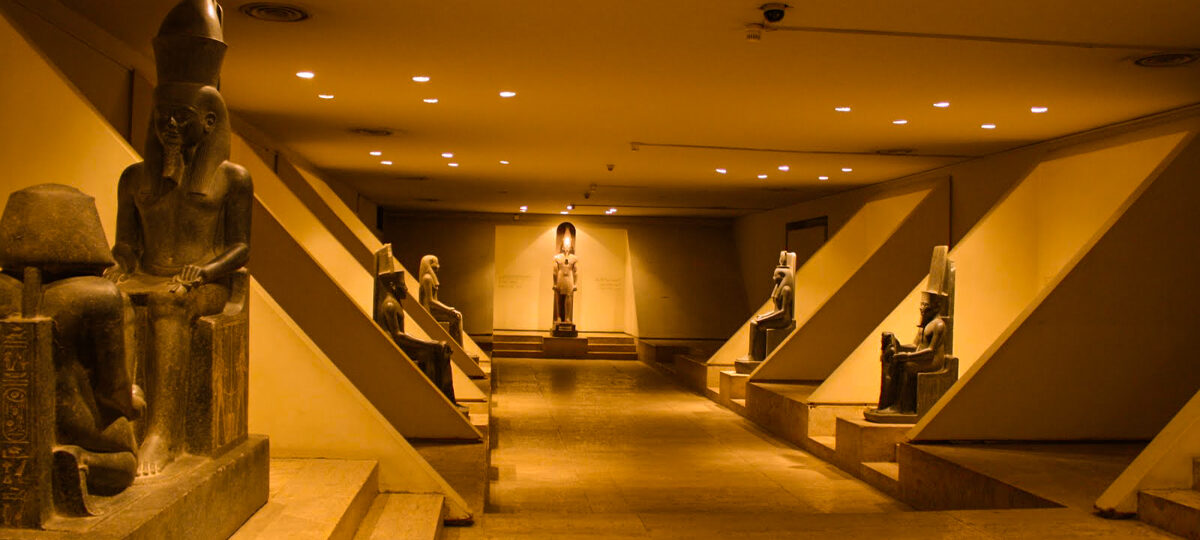
Luxor Museum
The Luxor Museum is one of the most modern museums in Egypt. Although it is not as big as the Egyptian Museum in Cairo, tourists can enjoy it better because, without a doubt, it is better equipped and illuminated. Located on the ledge, halfway between the temples of Luxor and Karnak, the Luxor Museum has a small but select collection of pieces from the end of the Old Kingdom to the Mamluk era. Still, most of it comes from the Temples and cemeteries of Luxor.
Opened in 1975, the Luxor Museum exhibits one of the best displays of Egyptian antiquities. In the main hall, two of the wonders that await are the head of the cow goddess rescued from the tomb of Tut-and-amon and a massive red granite sculpture of the head of Amenhotep III. The double calcite statue of the crocodile god Sobek belongs to the latter’s dynasty, which was discovered at the bottom of a ditch filled with water in 1967.
The best way to learn about the ancient Egyptian culture that thrived along the banks of the Nile is to take the Nile Cruises. So Don’t miss booking our Best Nile River Cruises 2026

The first floor of the Luxor Museum
Granite head of Amenhotep III in the Luxor Museum To the right of the museum entrance, we see a colossal granite head of Amen-Hotep III. It is one of many statues in his now-ruined mortuary temple, which stood alongside the Colossi of Memnon.
Head of the Goddess Mehit-West in the Luxor Museum.
Black and gold head of the cow goddess Mehit-West, one of the forms of the goddess Hathor and the deities of the afterlife. This head was part of Tutankhamun’s treasure. It is made of wood, lapis lazuli, and gold—an alabaster ensemble of Amen-Hotep IIl protected by the crocodile god Sobek.
The package was found in 1967 at the site of the Temple of Sobek in Dahamsah, at the bottom of a canal.- Granite head of Senusert III in the Luxor MuseumPiece No. 34 Ahead of Senusert III, made of red granite from Aswan. The king wears the double crown of Upper and Lower Egypt. In this statue, we can appreciate the realism in the characteristics of the king.
He is not idealized as the Egyptian artist used to be in the Old Kingdom but is serious and thoughtful. Second Floor – Scribe of Amenhotep, son of Hapu in the Luxor Museum Piece no. 4 Going up the ramp to the second floor, we can see the seated granite figure of the legendary scribe of Amenhotep, son of Hapu. Amenhotep was a great official who oversaw all the works of Amen-Hotep III and was in charge of carrying out many of the significant buildings of ancient Thebes. He was deified in the Ptolemaic era.
Akhenaten’s Wall in Luxor Museum
One of the most exciting pieces in the museum is the Wall of Akhenaten. It is a set of small sandstone blocks called (Talat) or “three,” probably because its height and length were about three sections. They formed part of Amenhotep IV’s contribution to the Temples of Karnak before changing the name to replace Akhenaten and leaving Thebes to Tall El Amarna, or Akhetaten. After his death, his buildings were demolished, and some forty thousand blocks were used to fill the ninth pylon of Karnak. They were found in the late 1960s. The fragment shows Akhenaten with his wife Nefertiti and scenes of temple life. This is the only example we have of the decoration of an Aten temple.
Check Our Top Nile Cruise Trips:-
- Standard Nile Cruise
- Deluxe Nile Cruises
- Luxury Nile Cruises
- Ultra Luxury Nile Cruises
- Lake Nasser Cruise Ships
- Dahabiya Nile Cruise
Luxor cache pieces at Luxor Museum
To the left of the exit is a small room containing 16 of the 22 statues discovered in the Luxor temple in 1989. The most critical piece is a 2.45-meter quartzite statue of Amenhotep III. Also interesting is a beautiful statue of the goddess Hathor made of diorite and some cartouches of the Nubian Pharaoh Taharqa.
